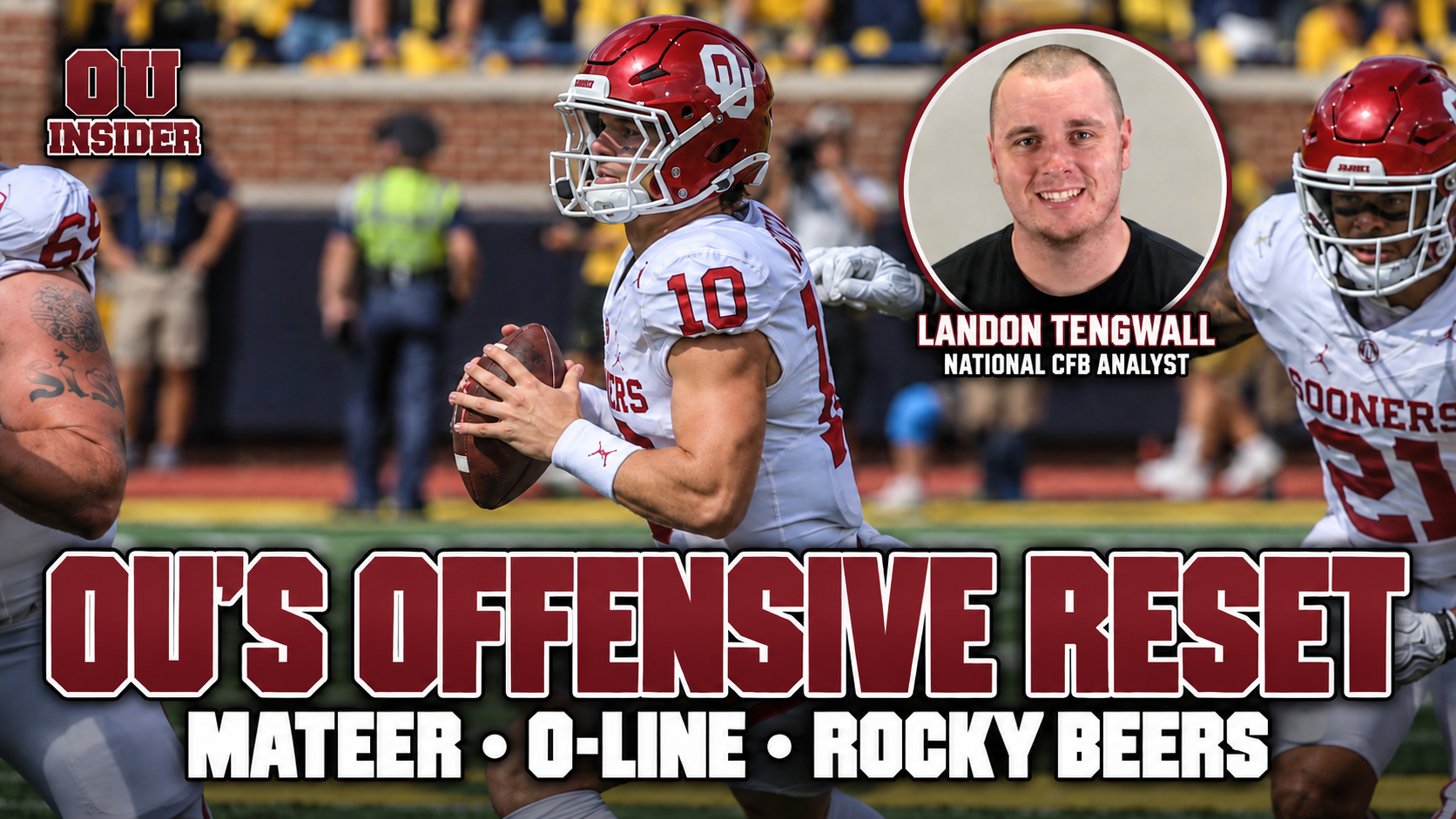
Oklahoma’s offense needs more than a different personnel grouping to solve what went wrong at Michigan.
That was one of the clearest takeaways from national college football analyst and former Penn State offensive lineman Landon Tengwall’s appearance on OUInsider’s Under the Visor Special. His review offered specific criticism of the Sooners’ execution, but also a path toward improvement.
“Week two, it can always be fixed,” Tengwall said.
The fixes, in his view, start with the offensive line, include a bigger role for Sooners tight end Rocky Beers, and require Ben Arbuckle to identify what this offense can consistently execute.
The problems start before the throw
Tengwall’s concerns were about more than linemen losing individual matchups. He pointed to unblocked defenders, protection identification and blocks that initially looked adequate before breaking down late.
Those details matter. A defender crossing a blocker’s face just before a running back reaches the hole can turn a productive carry into a short gain. Pressure from a three-man rush can also affect how a quarterback sees the pocket on subsequent possessions.
None of that excuses Oklahoma quarterback John Mateer’s inaccurate throws. Tengwall was critical of those misses, too. But his analysis was that Oklahoma’s struggles involved multiple parts of the offense, and assigning everything to one player or one play call misses the larger picture.
He also believed Oklahoma wide receiver Trell Harris’ route contributed to the costly interception, while making clear Mateer could have placed the ball better. That was Tengwall’s interpretation of the play—not an attempt to remove the quarterback’s responsibility.
A different tackle alignment
Tengwall’s preferred direction, when Michael Fasusi is available, is Fasusi at left tackle and Ryan Fodje at right tackle.
He was particularly critical of E’marion Harris’ pass-protection mechanics, describing footwork that brought his feet together and opened his hips too early. That creates problems for a tackle trying to stay balanced and respond to a pass rusher.
Fodje did not receive a pass for his Michigan performance. Tengwall did, however, stress the difficulty of moving to the left side with limited experience there, and he sees Fodje’s pass-setting ability as a reason to return him to the right.
“Overall, this offensive line needs to get some confidence back,” Tengwall said.
His proposed alignment is a recommendation, not an announced lineup change. But he believes getting players into more comfortable positions would give the unit a better chance to settle in.
Build more around Rocky Beers
If Tengwall’s offensive line evaluation was blunt, his assessment of Beers was considerably more encouraging.
He praised the tight end’s ability to set up defenders, sell the beginning of a route, create separation and produce after the catch. Those traits give Oklahoma options beyond simply attaching another blocker to the formation.
“You’ve got to scheme around Rocky Beers because I think he is going to be an absolute dude,” Tengwall said.
That could mean moving Beers into the slot, finding a favorable matchup against a linebacker or defensive back, or using play-action and movement throws to connect him with Mateer.
The personnel grouping can change with the opponent. The priority is finding ways to get one of Oklahoma’s most promising offensive weapons the ball.
More tight ends aren’t an automatic answer
Tengwall pushed back on the idea that 12 personnel—one running back and two tight ends—or 13 personnel, with three tight ends, automatically repairs a struggling running game.
Additional blockers can draw additional defenders into the box. That reduces space and creates more individual blocks that must be executed for a play to work.
He was not advocating abandoning those packages. He discussed using a tight end as a moving blocker, with opportunities to pull across the formation. However, Tengwall’s broader point was that heavier formations must fit the players and the matchup — not just become the answer simply because fans want to see them.
For Arbuckle, the task is identifying what this group can do well enough to repeat against SEC competition.
What needs to carry beyond New Mexico
Tengwall’s emphasis for the next game was confidence, cleaner execution and an offensive identity Oklahoma can carry into Georgia and Texas.
A productive performance against New Mexico would be a start. The more meaningful question is whether the Sooners are building habits and concepts that will hold up when the competition gets tougher.
He remained confident in Oklahoma’s defense and did not see enough on film to support taking defensive play-calling duties away from Brent Venables.
On offense, his outlook was more measured, but still hopeful.
“I feel like there’s enough talent here,” Tengwall said.
The challenge is turning that talent into reliable production: finishing blocks, making the available throws and giving Beers more opportunities. Oklahoma has things it can change. Now it needs those changes to show up on the field.